Wednesday, 8 January 2014

Animating- Dog animation Part 4

This is just a quick update on the progress that I have made so far. At the moment, I do see some benefits of the new workflow which I have decided to do for this project where I started with the main body, squash and stretch and then posing out the legs. I found some pros and cons to this.

Some of the benefits that I have found animating this way is that, I feel a sense of progression of my work and that I feel more confident with working with the graph editor, whereas normally it's quite confusing when working the graph editor after the blocking out my animation.


However I can see the cons in this, as sometimes I do feel like I'm animating in straight ahead, and I feel like I'm not getting anywhere. 

The two videos that are rendered out are in it's early stages and I can see a number of faults already. I have mainly focused on the body and quickly moved the legs into their key poses to get an idea of what it may look like in the future. 

One thing which has bugged me was that it felt as though the trot cycle was very slow. I think to be honest, that I have one too many poses in this and that I have to get rid of one. This problem had occurred when I was doing the run cycle with my character and that my mentor had pointed this out for me. 


I believe that the pose which I can get rid of, is the image below. The reason being is that it takes too long for the Nico leg to touch the ground. 
One too many poses
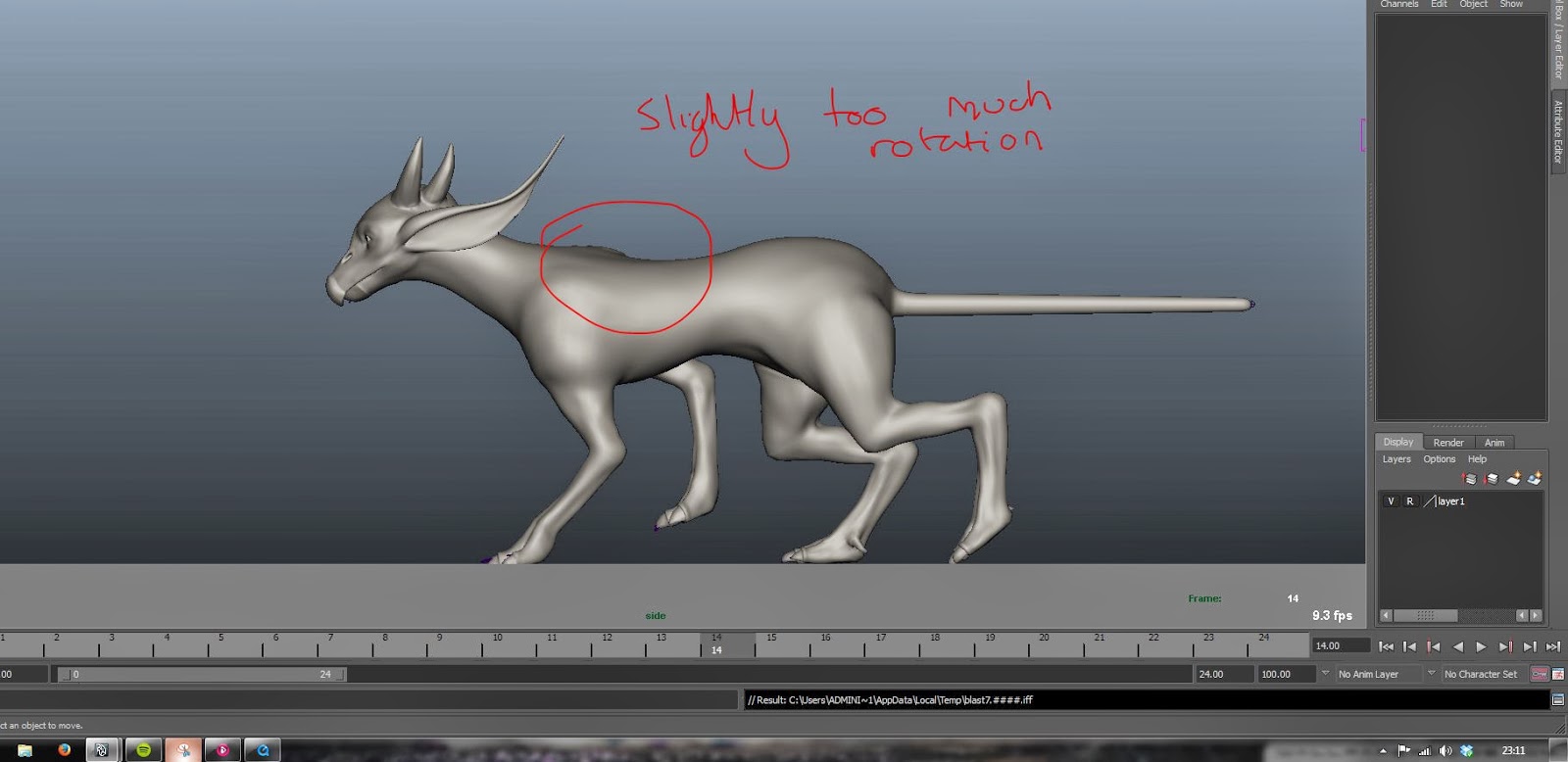
As this cycle is at it's early stage, I wanted to try and exaggerate some of the rig but, sometimes it doesn't always work out. The image below highlights the rotation of the Nico, where I think I should tone it down.

Rotation needs to be toned down
Even though I' trying to make this move as realistic as possible, I still think that there needs to be that touch of emphasis on the movements. I therefore think that the front and back needs to be clearly contrasted, to make it look more appealing. 

Contrast- feels robotic
I'm really pleased with the progress so far, even though it means going back and re-animating some poses again. 

Keep animating- try something new.

Tuesday, 7 January 2014

Trotting cycle and trying something new- Dog animation Part 3

Hello all once again. It's back to business and back to the dog animation. Although I had done a cheetah walk cycle from the previous month, I feel that it had lacked the necessary details and realism of a quadruped animation, and with all the research I had now done from Professor S. Sumida power point I feel that I have missed out an important task to getting it done right.


Trotting cycle- Key poses
Trotting Cycle- Key Poses

I have then replayed the reference video which is part of the storyboard that I have done and focused a certain cycle that the dog performs, in this case, "trotting". So, I would then animate this first and then go back and continue with the story. I feel that this would refresh and hopefully change the way that I will animate this time around.


Technical Difficulties

I then however ran into another problem with one of the rigs, where I wasn't able to save the file. This meant I had to find another Dog rig for the animation. I was going to give up when I found a video tutorial that had mentioned how the rig "Nico" was a very good one to use. So below, is the new rig that I will be using. It'll be kind of cool as I would then try to make this animal have a dog-like personality.

Nico Rig

The video that suggested this was a person that I'm currently following. He has some terrific videos and tutorials. The one thing that I like about some tutorials is that I get to see the methodology and hopefully find a tip that could help me animate that more efficiently. One of the things that I saw which I have tried doing and proved successful, was how he worked on the body first and emulated the bouncing ball effect. By doing this, you will have made sure that the creature or character will have that bounce life like effect (12 Principles of animation).

 
Basic Quadruped Walk Cycle Tutorial from Chris Sokalofsky on Vimeo.

I just want to mention that I'm not copying from this tutorial. This was mainly to educate myself to how another person workflow works. Plus, the person is going through a walk cycle rather than a trot, which I am trying to achieve. Read my previous post to learn more about the difference...or : A trot is when two feet are off the ground at the same time- unlike a walk -_-

As much as I hate to try a different approach to my workflow I thought, "when else is a better time to experiment and learn from your mistakes?". So as well as animating the body first, I'm also going to try and animate without blocking out my animation in stepped mode. Instead, I will still do pose to pose but, will do this in splines. This is another topic which was mentioned from Animator mentor, and already, it feels like refreshing approach. Like my friend once said, "everyone has a different workflow but will also reach the same conclusion".


I'm going to try and aim to complete most of the trotting cycle by the end of the week, though no garuntee as I might have to pop into work, lets hope not.

Keep animating, try something new.

Wednesday, 1 January 2014

Happy new year and projects completed

Happy new year! I hope you all had a wonderful time celebrating the new year. This will be the last few days of my break before I start to pick up where I left off, from the animation which I have had planned. Again, I apologise for the lack of work as I had more shifts at work and that the holidays were around. Got to enjoy life right?

I have however, have something to show to you guys which I'm quite pleased to have completed. I technically started on January 9th 2013 for this project but, I was able to recover other previous recorded content that I had done earlier of 2013. Anyway, the video below is based on my life where I have recorded each day for one second for one year. Each day had a meaning to me and are moments which were important.

As I watch the video, I have the sense of feeling of when times were good and I was full of optimism of my future but, then there is a point where I lose myself and start to lose heart of where I want to go in my career.  However, as I look at this as a whole picture, I realise what I must do in order to get where I want in this new year of 2014.


This video project would not have been possible were it not for "Cesar K."here is a link of his talk about his one second project idea. Thanks for his inspiring talk.

http://www.ted.com/talks/cesar_kuriyama_one_second_every_day.html

Sunday, 29 December 2013

On a holiday break

Hello there, I hope you guys have had a lovely Christmas and holiday so far. I particularly found this Christmas to be quite quiet compared to last year, this was probably due to the lack of board games that we had available to us with my family. None the less, it was still a very fun Christmas.

 I haven't been focusing much on the animation over the past couple of weeks as I had picked up a few extra shifts at work. Luckily, it hasn't been hectic as the customers may've been on a spending spree on presents and the sales that are going on. Still, there is New Year just around the corner and that could be a busy shift at work.

So as a small holiday present, I present you this video below which I had fortunately stumbled across on youtube. Happy Holidays and I'll see you next year!

Tuesday, 17 December 2013

Storyboard and more references - Dog Animation Part 2

Hello once again. I was hoping that I would have a lot more work to show but, due to the increase of shifts that I'm doing at my part time job I'm afraid that this project is slowing down which is kind of bad for me, as the time schedule I had planned myself for completing this project is going out of the window. Never the less, there is a flip side to this, I can therefore take a bit more time with this animation especially as I'm still on the storyboard stage. More drawings!

I have thought about what the animation would be about and compared to the one I had in mind from last week, the one which I have drawn out today is far more better, in terms of timing and storytelling. The video below is basically the storyboard, as I think it would be much easier for me to animate as close to it as possible. Reason being is that: I don't have a dog, haven't animated much of creatures before and by using this video as the base of my storyboard I can pick out the small personalities from the dog much easier. (Start video at 2:20).


I'm a bit more confident with animating with this even though there will be a few moments that will prove to challenging to do i.e when the dog is on top of the work table. It's certainly a lot more fun to animate rather than a walk cycle which I had planned on doing a few weeks back.


Storyboard 1 - Dog searching


I then storyboarded some of the key moments from the video. This again is still the early stages, so poses I may've missed are the contact poses and etc. Doesn't matter. I just needed a rough sketch of whats going to happen so, I can look back very easily on where I am when animating. I will however need to look at a bit more references as for example the image above, top right hand corner thumbnail, the back legs are wrong, as there was something blocking the leg, therefore it doesn't feel right.

Storyboard 2 - Dog searching


When I was drawing out the storyboard I found that it was rather enlightening experience. This really reminded me back in the days when I was still doing my A levels and when I was drawing something really passionately and I put all of my heart and soul into it. Sounds odd but, I feel as if I didn't have a job back then, then maybe, just maybe I could've applied my creativity in my drawings a lot better back at school. But that's all in the past now.

Storyboard 3 - Dog searching


So, as it's pretty much the last week before christmas, I will set myself the task to draw out the key poses of this animation. After christmas I should really be cracking on with blocking out in maya and if not, for some unseen reason, then I should model out the objects that will be staged in the scene.

Thursday, 12 December 2013

Drawing from references - Dog Animation Part 1

I haven't had a very productive day in terms with work but, I did however complete most of the christmas shopping earlier this afternoon. So, that's something to smile about. I have more or less have an idea of what my next animation will be about, it'll be based on a dog sniffing around. I then might link on with another idea to this.

So like before starting any animation or key poses, I then had a session of drawing dog references from videos, pictures that can be found online and so on. With the help of Stuart S. Sumida work, I then felt that it was necessary to look at the anatomy of a dog.

This proved to be useful as when I was then drawing from the references I can then figure out how long a leg is based on the dog anatomy. It made things easier as my drawing skills isn't that great at all.

Dog anatomy structure

 As well as looking at the dog anatomy, I then found the image below which highlights the dog's muscles.

Dog muscles 

As mentioned earlier my drawing skills isn't the best but, I hope that as I continue to do more of this, that I will gradually improve. You can see that the first image below on the left hand side of the page that I did a few warm ups before, I started drawing.

Few minute warm up

 I started drawing with a pencil but then found that when I used a blue crayon really relaxed my mind a little as it felt as though I didn't need to get it perfect. Some animators do in fact do this, where they start with a rough sketch and then go over in their work again to clean up the drawing on a different layer.

Anyone that watches CTFXC? - Spot Marley

Video above is one of the few references I've used

So my workflow is to find references, most of the time it's from videos as I can scrub through the video to find some interesting poses from the character or creature. I then just draw and make sure that the form of the body is right and has that feel of life. 

In the Zone
 There are times when my mind does seem to drift and the quality of the drawings does go down. At that point I sometime like to experiment in the way I draw then, where I draw more lines than it is necessary.

Slowly drift off

When I feel confident however, I start to draw in pencil again as it gives me that extra boost where I have to pay more attention to how a line is drawn.

Try to use pencil again and be more attentive to the way I draw

Planning the animation is something that I want to make sure that I get right. So, I think I will continue drawing just a bit more before finding my key poses.


Wednesday, 11 December 2013

Animal Locomotion- Stuart S. Sumida

Hello again guys, I was hoping to get some work done for my next animation which will involve a dog running. The problem I then ran into however was, I was a bit ambitous on what else I can animate a dog. Lots of brainstorming came up from the dog chasing a person, to it sniffing around to show a bit more personality. With all of these ideas popping up, I then had to reason with myself that I have to make sure that I get the basics right before animating anything. I then looked at dog videos from how they walk to chasing a ball.

Stuart S. Sumida teaching at a workshop


I then noticed however that some of the walk cycle of a dog is sometimes similar to the cheetah cycle that I had animated last week. I then  just had to be sure that I was seeing this right. I then remembered Stuart. S Sumida who talked about anatomy and how animals walked from the BFX festival a couple of months back. I then thought that there must be a presentation that maybe reflect some of his work about this.


I then found a powerpoint presentation which was similar to the one he had presented  at the BFX festival but, I also found another one, that had quite an extensive breakdown of different locomotion for animals.

Stuart S.Sumida

Reading Stuart's work was fascinating and it just goes to show why his wealth of knowledge had been so essential to the numerous animation studios, that he has worked along with. Now, I must admit that I found some of the powerpoint to be overwhelming but after a few minutes on youtube, watching the videos of how a dog walks, trots and so on, it has really helped me understand a lot more on the locomotion of them.

Now the image below is based on a walk cycle and the way to identifying this is that, "there will be a three point support or triangular under support".

Stuart S.Sumida - Walk has three point under spport

The video below will show different cycles of a dog moving, but for now let's focus of the walk of the dog, starting from the 8 second mark. The best thing about this youtube account is that they have provided a slow motion sequence, something which helps you see the finer details of the walk. Anyway, if you have watched the video now, you can see how the dog has three point under support.


You can also see this from another animal for example, the cat video below:


Trotting is when an "animal step cycle dominated by alternating diagonal under support". They are two types of trotting and they are:

- Two beat: "trotting is dominated by alternating contact with the ground.
- Four beat: "hind lands first before the fore member of each. What this means is that the fore (front legs) leaves the ground a split second after the hind (back leg) member of each.

So from watching the trot below, I think that this is a two beat trot. Correct me if I'm wrong.
 

The video below is about a canter vs a gallop from a dog. 


The process of a canter is when the animal is normally interacting with something, and is often a 3 beat digit sequence. It always starts with the rear leg and finally on the front leg, that  is diaagonal from the hind leg. So, if the right hind leg strikes the ground first, then the  front leg will lead and vice versa. This might be hard to wrap around, but watch the video over again to see this happening.

 A gallop however, will have a floating stage of the animal, both limbs are tucked underneath the body and will therefore extend forwards and back. This is also the highest speed of locomotion.  

I could talk more about what I had read and learnt from the powerpoint but that would take forever, plus right now blogger is being a pain with the fact it keeps glitching on me when I embed a video and there is now save button at the moment. I hope you found this a bit useful and if you want, I leave you a link to Stuart S. Sumida powerpoint below.